
How to install drainage for artificial grass.
Published 10 July 2026
In Singapore's downpours, drainage is what separates a lawn that's dry minutes after a storm from one that pools, smells and lifts. Here's how the base is built, on soil and on hard surfaces, so water runs straight through and away.
Good artificial grass has a perforated backing that lets water fall straight through, so the grass itself rarely floods. The question is what happens next. If the base beneath can't move that water away, it simply sits under the turf. Getting drainage right is almost entirely about the layers you never see.

Does artificial grass even need drainage?
Yes. The turf drains, but the ground has to as well. On permeable soil the job is to build a free-draining base that lets water percolate down. On hard, non-porous surfaces, tiles, concrete, a waterproofed roof deck, the water has nowhere to soak away, so you create a void beneath the turf and channel it to a drain. Two situations, two builds.
Draining onto soil: the layer cake
Over open ground, drainage is built into a compacted base:
1. Excavate and set a fall. Dig out to depth and grade the sub-grade with a slight slope, about 1 in 100, towards where water should exit.
2. Sub-base. Add and compact a free-draining aggregate (crushed stone / granite). This is the load-bearing, water-moving layer, and the one most DIY jobs skimp on.
3. Blinding layer. A thin course of sharp sand levels the aggregate and gives a smooth bed for the turf.
4. Geo-textile membrane. Rolled over the base to block weeds and stop the layers mixing, while letting water pass.
5. The grass. Laid, tensioned and edge-secured on top. Rain drains through the backing, through the sand and aggregate, and away into the ground.
Draining on decks, balconies and roofs: drainage cells
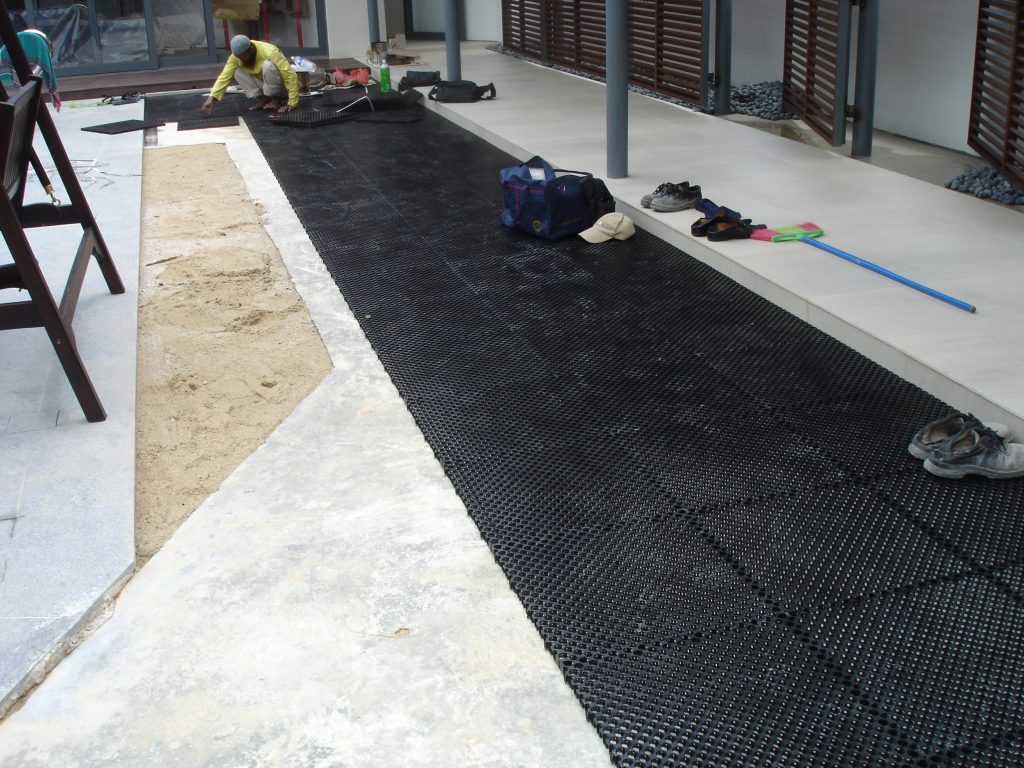
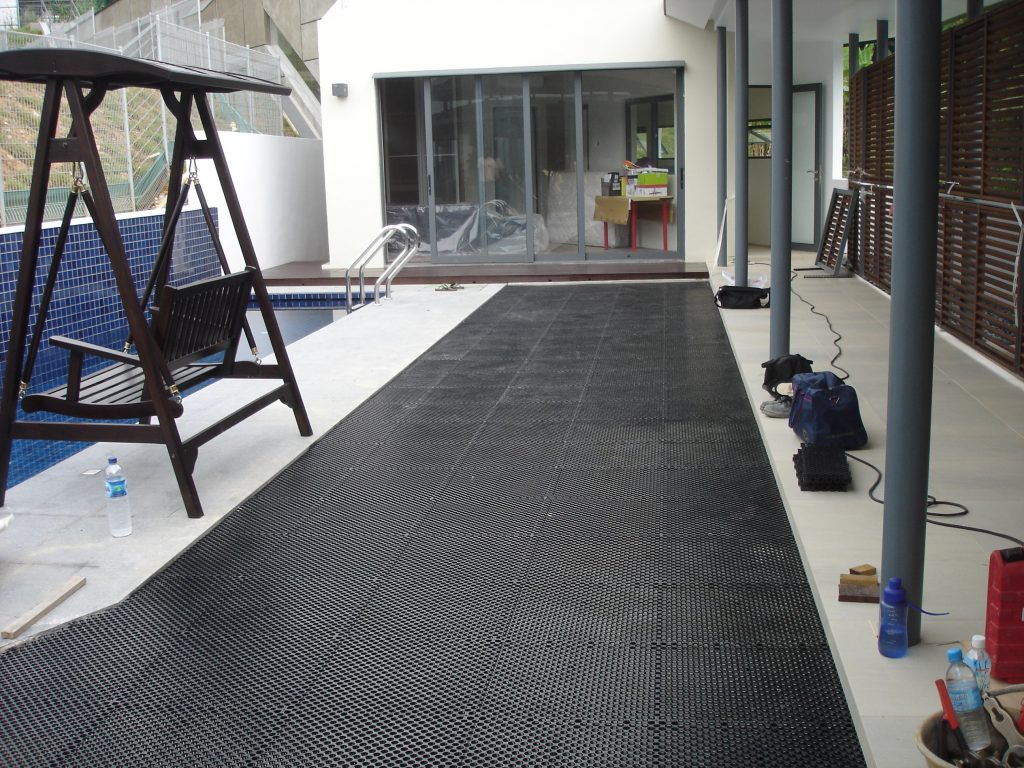
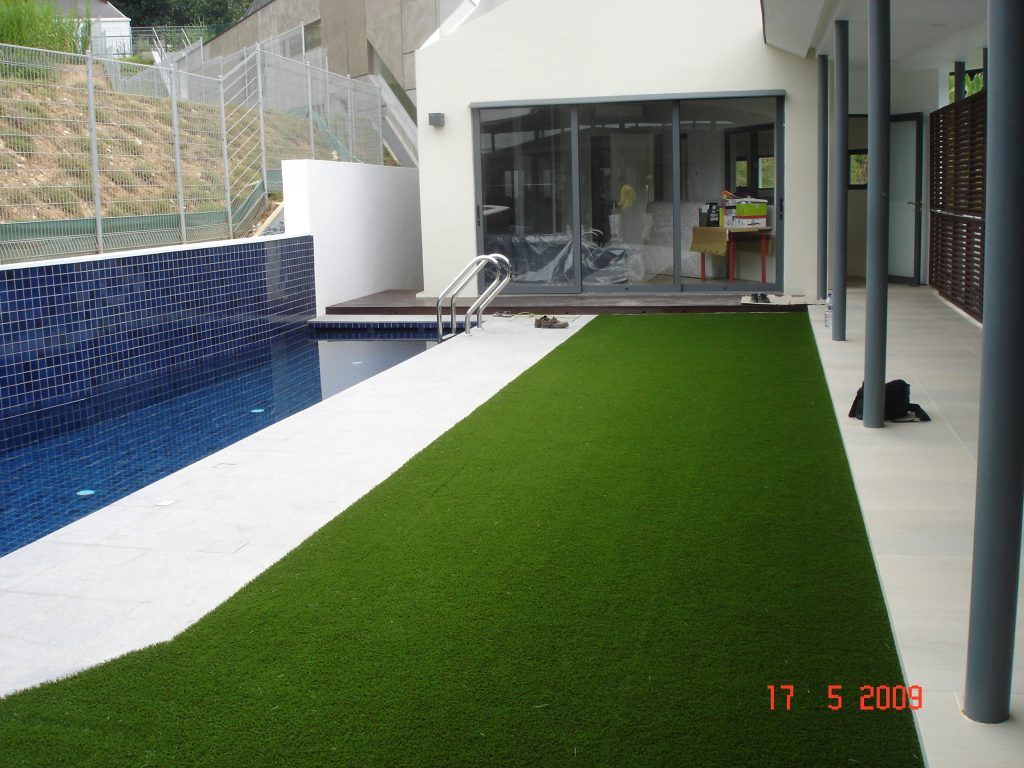
On a sealed surface there's no soil to soak into, so a compacted aggregate base won't help, water would just sit on the slab. This is where drainage cells come in: interlocking plastic panels that create a continuous air gap under the turf. Water falls through the grass, into the void, and runs across the cells to the existing floor drains or roof outlets, keeping the turf clear of standing water and the waterproofing protected.
The details that make or break it
Fall. A gentle slope of about 1 in 100 toward the outlet is invisible underfoot but essential, flat ground lets water sit.
Compaction. On soil, an under-compacted sub-base settles unevenly and traps water in the dips.
Perforated backing. Only turf with a properly perforated backing drains freely, some cheap grass has a solid backing that holds water on top.
Clear outlets. On decks and roofs, the drainage cells must actually run to a working drain, and those outlets need to stay clear.
Building a base, or want it built for you?
We supply VersiCell drainage cells, membrane and premium perforated-backing grass, and we install the whole build-up so it drains for good. See the product, or get an exact quote.
FAQ
Does artificial grass need drainage?
How do you install drainage under artificial grass?
What are drainage cells and when do I need them?
How much fall does artificial grass drainage need?
Give your pet a lawn built for them.
Tell us about your garden and your pets, and we'll quote premium, pet-safe turf laid to last.
Chosen by Singapore's landmark names
From resort poolsides and hotel rooftops to preschools and attractions — a selection of the clients who trust our premium Namgrass installs.
 Shangri-La Rasa Sentosa
 Holiday Inn
 iFly Singapore
 Royal Albatross
 Far East Plaza Residential
 PCF Sparkletots
 Marina Bay Sands